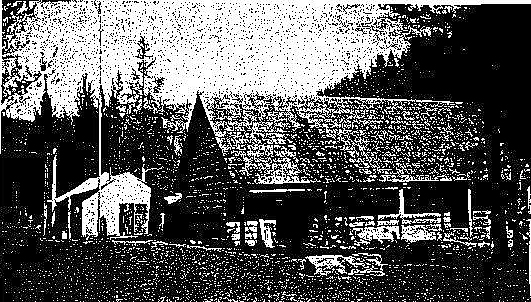
Big Creek Commissary during its construction circa 1925.
10VY532/PY-797
U.S. Department of Agriculture, Forest Service
Payette National Forest, Heritage Program
June 2002
The Big Creek Commissary, located on the Krassel District of the Payette National Forest, is listed on the National Register of Historic Places. It was constructed in 1924 and 19925 and represents one of the few remaining "log cabin" era buildings on the Payette National Forest .Located at the Big Creek Ranger Station complex, the commissary is accessible via Forest Service Road #371 or by air via the Big Creek airfield.
The vicinity of Big Creek was first used in the early 1920's as a ranger headquarters. Fred Williams tells of his experience. "The next season, 1922, headquarters was established in a set of old mining cabins on Smith Creek (two miles north of the present site). The Station headquarters had been moved from Ramey Ridge - said cabin had been used as a barn, no floor or windows- it was quite a classy place. That fall we moved to Edwardsburg (1/2 mile south of the present site)… In 1923 we established headquarters at what is now Big Creek headquarters - the Ranger Station was a 7' X 9' tent the warehouse and office consisted of two 14' X 20' tents and the cook shack was made of whatever old canvas we could find." The development of the Big Creek Ranger Station complex occurred over the next few years.
Big Creek Commissary during its construction circa 1925.
The architecture of the building is ingenious. The log walls have been left in their natural round profile. The ends have been hewn and square notched. The joints where the interior room dividers meet the outside wall have also been square notched creating a neat seam. The overall effect is very uniform in materials and craftsmanship.
What is unusual about the Big Creek Commissary is the size of the log building, and the internal supporting log diaphragm system used to strengthen and stiffen the roof. Three structural walls, each constructed of 16 horizontal logs spanning from north to south, support the log purlins. There are no trusses supporting the roof of this massive log building. The rustic design was used out of necessity, based upon the availability of materials, skilled craftsmen, and the isolation of the setting from towns and sawmills. Logs were the only available building material, the builders knew the construction techniques and they were acceptable to the agency directed to manage the forest resources.
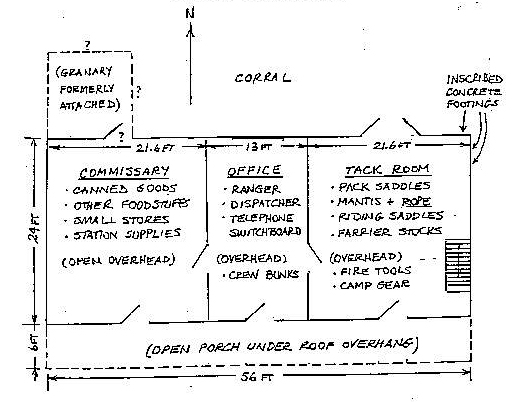
Big Creek Commissary (now called barn, PNF#1303) floor plan and functions, circa 1939 Sketch by Peter Preston, 12 Jan 1997>P>